
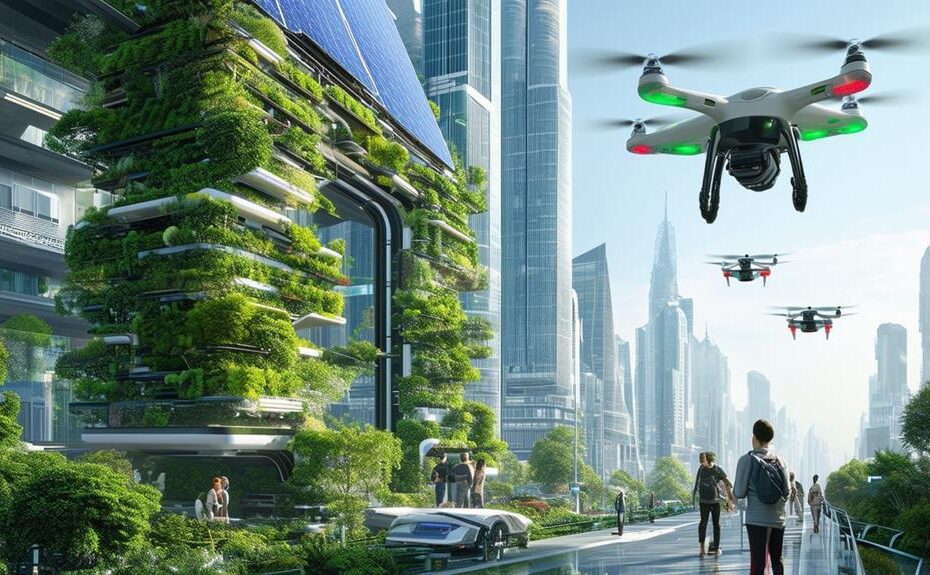
By 2050, you'll find yourself in a world where technology and sustainability redefine your daily life. You'll connect through advanced virtual realities, and robots will be your everyday assistants. Healthcare will be highly personalized with treatments tailored to your genetic profile, and cities will function as green, thriving ecosystems due to smart urban planning. Your commutes will transform with flying cars and ultra-fast hyperloops, making travel cleaner and more efficient. As you navigate this advanced society, every aspect of your life will weave through these innovations, from how you work to how you socialize. Curious about how these changes will specifically affect you? Uncover more as you explore this future landscape.
Technological Innovations by 2050

By 2050, groundbreaking technologies will transform how you live, work, and interact with the world. Imagine slipping on a virtual reality headset and instantly connecting with friends from around the globe, not just chatting or video calling, but sharing experiences as if you're together in the same room. These virtual reality experiences will create a sense of closeness and belonging, bridging distances and bringing people together like never before.
In your daily life, robotics will play an integral part. You'll wake up to the aroma of coffee brewed by your robotic kitchen assistant and head out to find your lawn perfectly manicured by a robotic gardener. These robots won't just be tools; they'll feel like companions, programmed to understand and anticipate your needs. They'll handle mundane chores, leaving you more time to connect with others and pursue what truly matters to you.
This integration of virtual reality and robotics won't only streamline your daily routines but also enhance your ability to engage with your community and broaden your social circles. You'll find belonging in this new digital era, surrounded by technology that brings people together and makes life smoother and more enjoyable.
Future of Artificial Intelligence
Building on the integration of technology in daily life, the future of artificial intelligence promises to redefine the boundaries of human-machine interaction. You'll find yourself seamlessly collaborating with machines more intuitively than ever before. As AI grows smarter, so too does its ability to understand and adapt to your needs, making your everyday tasks simpler and your decisions more informed.
However, with great power comes great responsibility. You'll wrestle with complex ethical dilemmas, such as how much autonomy to grant machines in workplaces and personal life. The integration of AI will provoke questions about privacy, security, and the moral implications of AI decisions. It's crucial that you engage in these conversations, as your voice will help shape the principles guiding AI development.
Moreover, the workforce impact will be significant. Many of your jobs will evolve, some will disappear, and many more will be created. You'll need to adapt to new roles that require working alongside AI. It's an opportunity for you to learn and grow, ensuring you're not left behind as the landscape shifts.
Embracing these changes will allow you to thrive in a future where human and machine collaboration is the norm, not the exception.
Climate Change and Sustainability

As you look towards 2050, understanding the critical role of climate change and sustainability is essential for shaping a livable future. The choices you make now significantly influence the health of our planet.
Embracing renewable energy and green architecture isn't just a trend; it's a commitment to ensuring the Earth remains a welcoming home for everyone.
You're part of a global community where every action towards sustainability strengthens the bonds between us all. By integrating solar panels, wind turbines, and other renewable sources into your daily life, you're not only reducing carbon footprints but also setting a standard for future generations.
It's about being a steward of the environment and a pioneer in the movement towards a greener world.
Green architecture plays a pivotal role too. Imagine living and working in buildings that align with nature, designed to be energy-efficient and environmentally friendly. These structures don't just stand; they breathe and coexist with their surroundings, enhancing your connection to the environment.
Advances in Healthcare Technology
Healthcare technology's rapid advancement will revolutionize how you manage and improve your health by 2050. Imagine a world where you're connected to your doctor not just by occasional visits, but continuously through remote monitoring. This isn't just about tracking your heart rate or steps; it's about your doctor knowing in real-time if your blood sugar spikes or your blood pressure drops. Personalized medicine will tailor treatment specifically to your genetic makeup, drastically reducing the trial-and-error in finding the right medication for you.
The use of nanotechnology in medicine will allow for incredibly precise interventions at the cellular level, potentially curing diseases before they manifest any symptoms. Think about tiny robots traversing your bloodstream, repairing cells, and eliminating pathogens. It's like having a microscopic health army dedicated just to keeping you healthy.
Robotic surgery will transform operations into less invasive procedures, with precision that reduces recovery time and minimizes risk. These robots won't replace your surgeons but will enhance their capabilities, making surgeries safer and more successful.
You'll no longer feel isolated or anxious about your health; you'll be part of a community that's supported and safeguarded by cutting-edge technology. It's a future where everyone has the chance to live their healthiest life, connected and cared for through technology.
Evolution of Urban Spaces

Just as technology is reshaping healthcare, it's also transforming urban spaces to make cities more livable and sustainable.
Imagine living in a city where every development is a part of a bigger, greener picture. Urban planning isn't just about creating space; it's about designing environments that nurture your well-being and sense of community.
The future is all about smart cities infused with green infrastructure. These aren't just buzzwords; they're the foundations of a world where you feel deeply connected to your urban environment.
Sustainable design is at the heart of this transformation. It ensures that as cities expand, they do so with a minimal environmental footprint, integrating nature right into the urban fabric.
Think vertical gardens on skyscrapers, green roofs, and expansive parks that are just a short walk from your home. It's about creating spaces where you and your neighbors can gather, reinforcing a sense of community.
Urban spaces are evolving from concrete jungles into green, thriving ecosystems. As we move towards 2050, you'll see cities that not only look different but feel different.
It's a place where you belong, a community that grows together, sustainably and smartly.
Transportation and Mobility
Transportation in 2050 revolutionizes how you travel, making journeys quicker, cleaner, and more efficient. Imagine stepping out of your home directly into a world where flying cars and autonomous vehicles are the norm. You're no longer just a commuter, but a part of a dynamic, interconnected community. These innovations ensure that you're spending less time on the road and more time enjoying life.
In smart cities, every element of your journey connects seamlessly. The streets are less crowded; the air, fresher. You feel a strong sense of belonging as shared autonomous vehicles whisk you to your destination, using routes optimized in real-time by advanced AI systems. You're not just moving; you're flowing smoothly through a well-orchestrated symphony of mobility.
Then there's the Hyperloop transport, offering speeds previously unimaginable. What once took hours now takes minutes, bringing distant places closer and knitting communities together like never before. It's not just about moving faster, but also about creating connections and building relationships.
You're part of something larger—a global village on the move, constantly evolving and growing together. Each trip you take doesn't just get you where you need to go; it brings you closer to the rest of the world.
Changes in Global Economy

As we explore the advancements in transportation, it's equally vital to understand how these innovations fuel significant shifts in the global economy by 2050. You're part of a world where economic growth and sustainability aren't just buzzwords but are integrated into every facet of global trade and business practices.
These changes aren't happening in isolation; they're about you, your community, and our collective future.
The rise of automation and smarter logistics solutions means that goods move faster and more efficiently across borders. You'll see economies thrive as they leverage these technologies to reduce waste and enhance productivity. This isn't just about big corporations either; it's about small businesses and startups finding their footing in a more connected, automated world. You're not just observing this shift; you're an integral part of it.
Sustainability becomes the backbone of economic policies. As you adapt to more sustainable living standards, you're also contributing to a larger, global effort to protect our planet. Economic strategies that focus on renewable resources and energy efficiency become the norm, not the exception.
This global commitment ensures that as the economy grows, it does so without compromising the health of our environment. You're not just living through these changes – you're driving them.
Education and Learning Methods
By 2050, you'll experience a revolution in education and learning methods, tailored to meet the challenges of a rapidly changing world. Imagine logging into your personalized virtual classroom each morning, where interactive learning tools are designed just for you. These adaptive technologies will analyze your learning habits and tailor content to optimize your understanding and retention. It's not just about making learning easier; it's about making it more effective for everyone, no matter where you are or what your learning style might be.
You'll find that education isn't a one-size-fits-all model anymore. Personalized education plans, powered by sophisticated algorithms, will cater to your unique needs and pace. Whether you're a visual learner who thrives on interactive simulations or someone who prefers detailed textual analysis, the system adapts to help you learn best. This inclusivity ensures that no one is left behind, fostering a sense of belonging and community among learners globally.
Moreover, the collaboration in virtual classrooms will connect you with peers from around the world, breaking down previous barriers. This global network not only enhances cultural understanding but also enriches your learning experience, making education a truly collective endeavor.
Social and Cultural Shifts

Navigating through the social and cultural shifts of 2050, you'll witness a dramatic transformation in global interconnectedness and identity perception. These changes aren't just abstract concepts; they're about how you live, interact, and belong in a rapidly evolving world. As cultural norms evolve, you'll find yourself adapting to new ways of thinking and behaving that prioritize community and collective well-being over individual success.
This era is defined by a fluid exchange of ideas and values, making the social dynamics more inclusive yet complex. You'll see that your sense of identity isn't tethered to just one nation or culture but is part of a global tapestry. This isn't just about accepting diversity—it's about embracing a shared future where everyone's unique contributions are valued.
In this interconnected world, communication barriers are a thing of the past. You're as likely to collaborate with someone in a distant continent as you're with your neighbor. This new proximity, brought about by advances in technology and transport, fosters a deeper understanding and respect among different cultures.
As you navigate these shifts, you'll find a richer sense of belonging in this diverse yet unified world. You're not just adapting to these changes; you're shaping them.
Conclusion
By 2050, you'll navigate through a world transformed by technology and innovation. You'll interact with advanced AI, live in sustainable urban spaces, and benefit from groundbreaking healthcare.
Your commute will be swift and eco-friendly, thanks to new transport solutions. As the global economy shifts, your job might look different, but education will be more tailored and accessible.
Embrace the change, for it promises a future where cultural and social advancements enrich everyone's lives profoundly.
Related articles: What Will Be Invented by 2050? · What Is the Next Big Thing in Technology 2025? · Will the Internet Be Gone in 2025?